
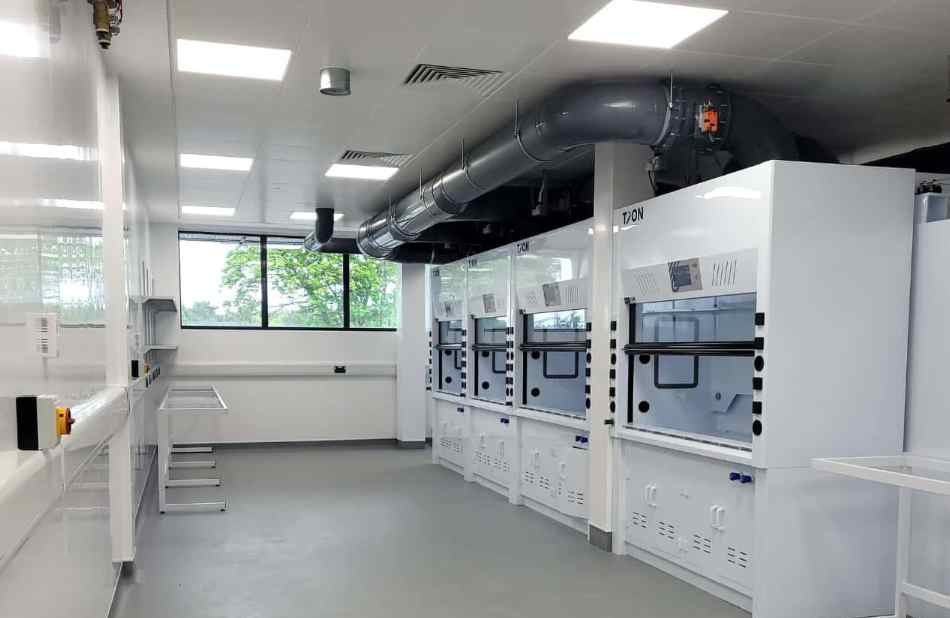
A school is fitting out a new science room, and the builder wants one line on the order form. A fume cupboard is an enclosed workspace that draws vapours, fumes, aerosols and dust away from the user, normally through ductwork to outside. What goes on that line depends on what will be used inside it.
What Should You Specify for a Fume Cupboard?
Write down the chemicals and tasks first, because they decide the construction. Johndec builds cupboards from flame retardant thermoplastics, and the grade is chosen to suit the application and the chemicals used. Then settle the details:
- Single-sided or double-sided, walk-in or down draught
- Custom size to fit the room, since units are built to your requirements
- A teaching version for a school, or access that meets disability requirements
- A special-application build for perchloric acid, hydrofluoric acid, radioactive materials, flammable reagents or high-temperature work
- An airflow monitor, plus the exhaust fan and scrubber that serve it
Johndec states that its cupboards comply with Australian Standard AS 2243.8, and that they are wholly manufactured in Australia.
Why Does the Exhaust Side Matter as Much as the Cupboard?
The cupboard only contains the hazard. The fan, ductwork and scrubber carry it away, so a weak exhaust makes a good cupboard perform badly. If the exhaust is not working properly, the cupboard may not protect you at all.
Corrosive fumes also attack metal, which is why plastic ductwork is common. On a large university science building, Johndec supplied cupboards, duct-mounted scrubbers, exhaust fans and over 1.5km of uPVC ductwork. Specifying the whole system together avoids mismatches between parts.
How Do You Use a Fume Cupboard Properly?
Treat it as a workspace, not a store. Items kept inside block airflow and interfere with containment, and hazardous chemicals belong in approved safety cabinets. Keep only the minimum amount needed for the procedure inside.
Airflow is easily disturbed. Foot traffic, opening doors and windows, supply air diffusers and outside fans all create crosscurrents. Position the cupboard away from them, and move slowly in front of it.
Before each use, check the airflow monitor and look for blockages. Clean spills straight away and wipe the glass. Have the extraction system serviced every year.
Where Should You Place It in the Room?
Place it where traffic and drafts are least likely, ideally away from doorways and supply air. The benchtops and furniture around it matter too, because they shape how air reaches the opening.
Leave clear access for maintenance and filter or fan service. Planning this during fit-out is far cheaper than moving a cupboard later.
Frequently Asked Questions
Is a fume cupboard the same as a fume hood?
In practice the terms overlap. Both enclose a work area and remove hazardous fumes. A fume cupboard is usually ducted to outside, while a fume hood can also be a ductless, filtered unit that returns cleaned air to the room.
How often should a fume cupboard be serviced?
The extraction system should be serviced every year. Between services, check the airflow monitor before each use, keep the opening clear of clutter, and confirm any carbon filters are clean and not saturated.
Can a fume cupboard be made to a custom size?
Yes. Johndec builds fume cupboards to specified sizes and requirements rather than only offering fixed models. Share your room dimensions, chemicals and access needs with the team, and they will advise on a suitable design.