
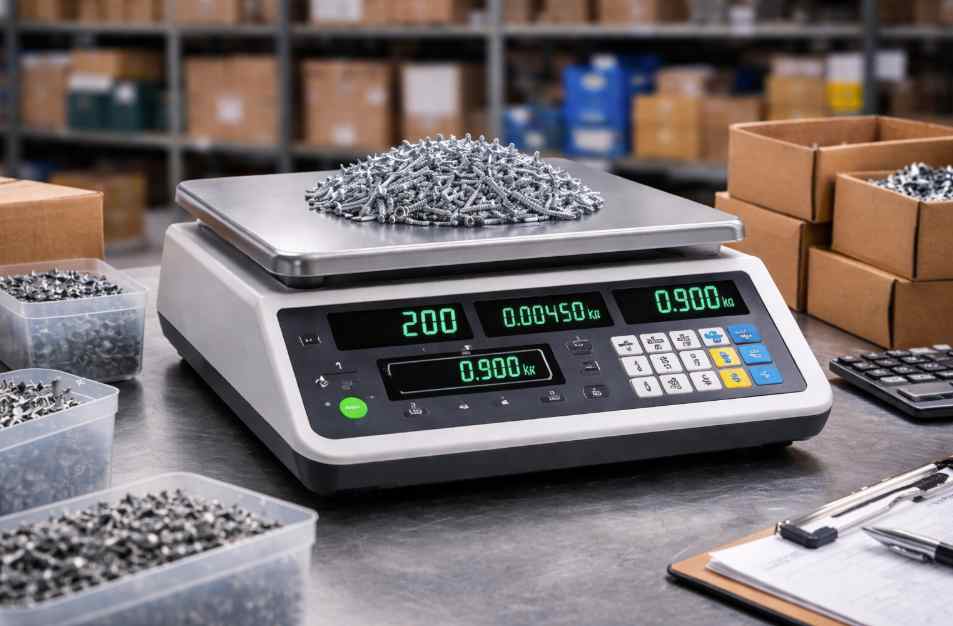
Managing small parts, hardware, and components by hand is time-consuming and prone to human error. Businesses that rely on manual piece counts often experience costly inventory discrepancies, packaging mistakes, and operational slowdowns.
If you want to streamline stock audits and packaging tasks, explore high-precision digital counting scales to discover how automated piece counting boosts overall warehouse productivity.
Why Modern Warehouses Rely on Counting Scales
Counting scales use sample weight calculations to determine exact quantities in seconds, eliminating tedious manual counting.
- High Precision: Calculates piece counts down to minute fraction weights accurately.
- Time Savings: Cuts stocktake and inventory auditing times by more than half.
- Accumulation Memory: Keeps running totals across multiple batches effortlessly.
- User-Friendly Interface: Features clear displays for total weight, unit weight, and piece count.
- Waste Reduction: Prevents overfilling and accidental shortfalls in product packaging.
Practical Applications Across Different Work Environments
These versatile weighing instruments serve a vital role across a wide range of industrial and commercial settings.
Manufacturing and Assembly Lines
Assembly operations depend on accurate counts of screws, fasteners, electronic components, and plastic fittings. Counting scales ensure workers grab exact quantities for assembly kits without stopping to count each piece individually, keeping assembly lines running at top speed.
Warehouse Inventory and Stocktakes
Conducting annual or quarterly inventory checks often requires days of manual labor. Digital units allow warehouse staff to verify bulk container quantities in moments, significantly reducing labor expenses and inventory reporting discrepancies.
Packaging and Distribution Centers
Fulfillment centers use piece counting scales to package predetermined product quantities accurately. This prevents shipping incomplete customer orders while protecting profit margins from unintentional over-packing.
Conclusion
When choosing a counting scale, look closely at internal resolution and sample accuracy. Higher internal resolution allows the scale to detect lighter individual pieces, ensuring reliable counts even for tiny components.
Dual-platform connectivity and rechargeable battery options are also worth considering for flexible warehouse use. A reliable system ensures seamless daily operations and long-term durability.